


































































Do you have an awkward critique for your professor that you don’t know how to properly address? You probably aren’t alone, but, there are solutions.
You may be too busy during testing weeks to fill out the IDEA forms, or think there isn’t much point. But there are solutions to this ever-present issue that can provide more accessible mediums for functional feedback.
The IDEA forms are great, and do a fabulous job evaluating professors in a lot of ways that are especially important for them and the Faculty Review Committee. But they have many issues that could use some reform.
While incredibly useful when available, these forms can’t be kept open for long; they can take a while and low response rates can hinder any growth from happening.
To get a better understanding of the situation, I talked with Jane Simonsen, a professor of history, Faculty Review Committee member and chair of American studies at Augustana.
“You get lower rates on some of the more gen ed classes, which is too bad because those are the ones that probably need some more feedback on them,” Simonsen said.
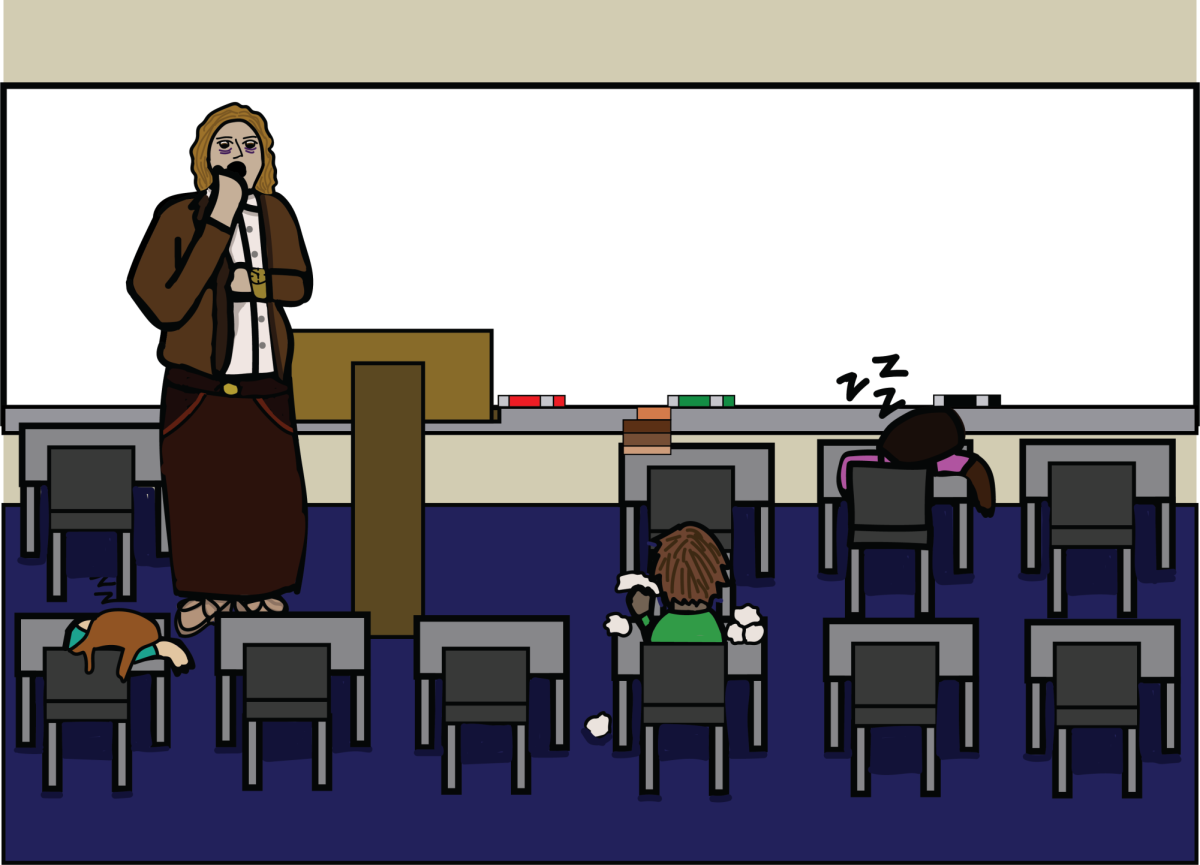
Students may assume that class structures are unchangeable, or they just want their classes to be over with, without thinking about how to improve them. By inviting students to participate in how they learn, we can increase engagement and take their perspectives into account.
Simonsen emphasized that professors should be the first source of problem-solving and that the review board is more of a secondary provision. Well, how can they, if response rates vary, and the time to respond is limited? Will they get all the information they are looking for, or that would help them in important ways? Beyond assumptions, professors won’t get much without students somehow being prompted.
“[The forms] used to be [done] in class, and I think we got more likely to get feedback when you took 20 minutes out of class to do it,” Simonsen said.
What if, instead of such limited time, and such forced formality, there was a more casual, always-open supplement that anyone could use? This could be a safe place to bring up those awkward conversations that you don’t know if you can have with your professors, make comments, observations or just share how you or the class are feeling.
“I think it would be worth exploring,” Simonsen said.
By opening up a simpler, anonymous, yet officially-reviewed form, students (especially First-Years) could have a clearer path of action towards dealing with professor problems. This wouldn’t have to just be for problems, but for solutions, ideas and more. After all, this is the marketplace of ideas- and students should have more participation in it.