













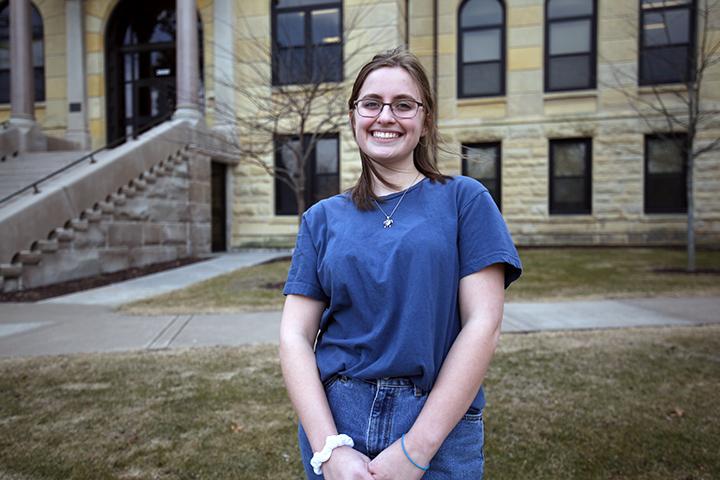



Augustana College sent a team of four students to participate in the Chartered Financial Analyst (CFA) local Research Challenge, hosted by the University of Iowa on Feb. 19. Led by senior Ronish Sangachhe, the Augustana team placed second out of nine teams competing. Despite their second place finish, they did not advance to the next round of challenges.
According to the CFA Society Iowa, the CFA Institute Research Challenge is an annual global competition that connects college students with investment professionals and provides hands-on mentoring in financial analysis. Students are required to research and analyze a publicly traded company and write a research report on their assigned company, providing a recommendation to buy, sell or hold the company’s stock, with this year’s selection being O’Reilly Auto Parts.
Senior Isaac Pacheco said that each team member had their own sections, but they all helped with the final presentation and report structure.
“My specific section was the investment risk and business description section,” Pacheco said. “I helped with ESG [environmental, social and governance], collecting data, and I also did some relative valuations.”
Since mid-October, the team met twice a week in preparation for the event, working on their recommendations until the event day in February.
Junior Thao Linh Phan said that the team spent a lot of time together preparing for the challenge. The team had intense meetings, sometimes lasting between five and six hours, as the challenge day approached.
“We team up together and support each other,” Phan said. “It’s not just a project or a challenge that we did.”
Phan primarily prepared the history overview for the group’s presentation but also contributed to the relative valuation and financial analysis. She also helped when other team members had questions.
Senior Chris Alkas was mostly responsible for the ESG portion of the project. One challenge the team faced was limited access to certain financial databases used by larger universities.
“Other schools had access to resources that we just didn’t have,” Alkas said.
Alkas said that this experience improved his presentation skills and helped his confidence in learning new things. He also said that the project allowed him to apply classroom knowledge to real-world situations.
“The most exciting part was proving to myself that I have the skills to succeed in the actual workforce,” Alkas said. “This is as real-world as it gets.”
According to Alkas, the project’s extent was larger than many students anticipated, requiring team members to learn new concepts on the spot.
Despite the challenges, Alkas said the experience was rewarding. He said this project has helped him prepare for a future career in financial analytics.
“It was extremely stressful,” Alkas said. “But I enjoyed the work we did, and I would do it again.”
