























































































How long is your attention span? Can you finish this article without distractions?
Our attention is for sale, and we barely even notice. All around us, all the time, our attention is beckoned, and we don’t realize until it’s too late. Yet, we think that having our most addictive distractions with us, smartphones, at all times is a necessity. How ironic!
Many Augustana teachers have completely banned smart technology from the classroom, while others welcome it or ask that it be limited in an effort to avoid distraction. Instead, we should utilize our technology more effectively than we currently do.
Professor David Snowball of Augustana’s Department of Communication Studies puts it bluntly.
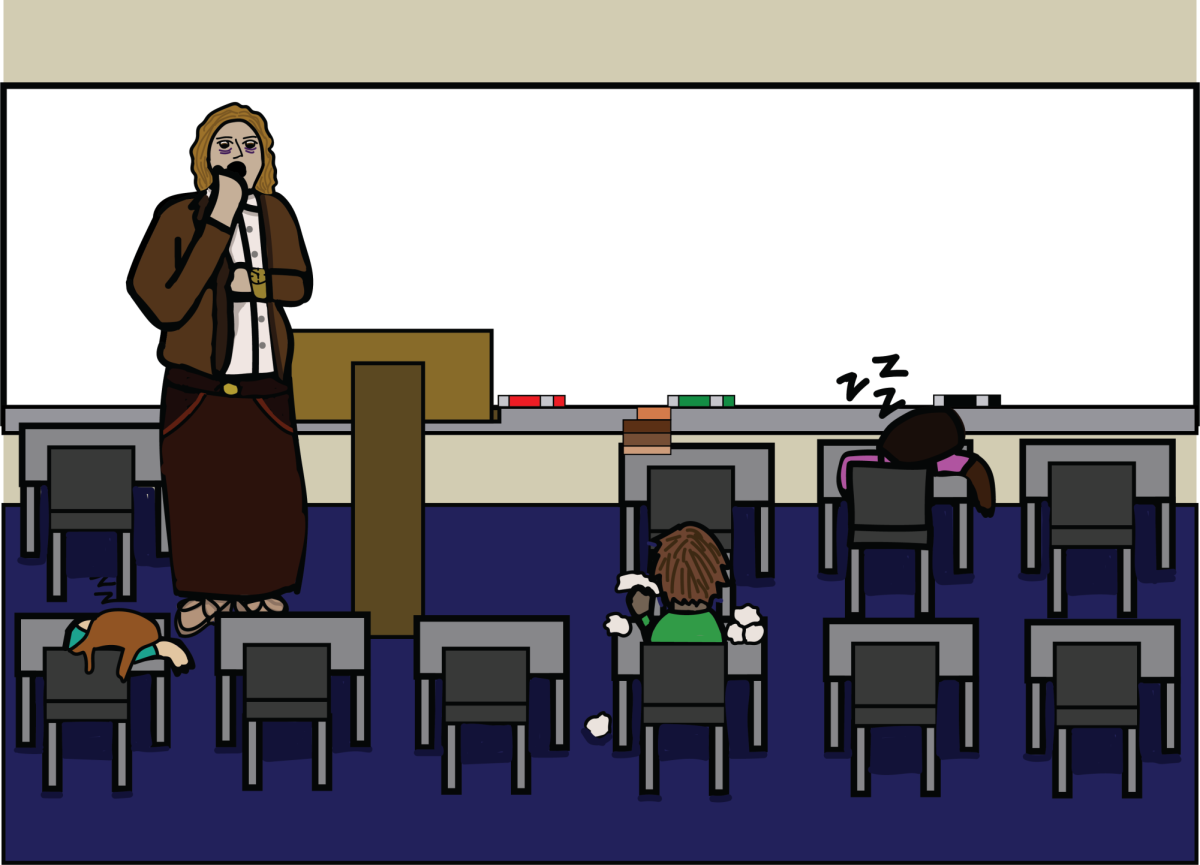
“You are addicted to [smartphones] when they’re there. You are physically uncomfortable having a cellphone present and not being checked.” Snowball said. “As a result, college students, on average, check their phones 22 times in the course of one class.”
This isn’t just about being “lazy” or shaming anybody; it is about a real problem that we as humans must learn to overcome. We are paying to go to college, to learn, to discuss and dream, and yet we distract ourselves at every instance of discomfort.
The distractions these devices create can interrupt, or even reset, our flow state.
“Paying attention generally implies that you exclude other inputs so that you can focus on a single stream of ideas or words or thoughts or images,” Snowball said. “The rule of thumb sometimes invoked is that it takes you about 15 minutes to get into [a flow state].”
What do college students want? To learn, grow and flourish. That’s why we are here, isn’t it? Snowball claims our phones prevent us from fully maximizing our learning, and by using them, we cheat ourselves out of the chance to grow.
So, what else should we aim for in the classroom?
“The ideal is you stop and think, ‘What the hell does that mean? What did they just say? Is that right? And what part of that is important?’’” Snowball said.
Snowball also mentioned a study where students’ computer activity was tracked in class, and it was found that they spend over 60% of their time in the “fun” tab instead of the “class notes” tab.
Physics Professor Nathan Frank said he sees this as an issue.
“Smartphones are built to be a distraction in order to make money,” Frank said. “Phones are super tools, but often they’re distractions? You should use it as a tool.”
So, what’s the solution?
“We set up new rules that allow us to gain whatever the advantage of the technology is, while trying to box out some of its most corrosive effects,” Snowball said.
My chemistry professor thought it was a waste of our “precious” brain space to memorize the whole periodic table. Snowball explained this concept in depth to me.
“Cognitive offloading: the idea that you are delegating certain functions that your brain could do to things outside of your brain,” Snowball said.
This doesn’t mean allowing technology to think for us, but rather, storing it for us so that we may think better or deeper or more creatively. Thinking better is why we are here, isn’t it? So, what might be our direction?
“The short answer is do hard things,” Snowball said. “There are very, very, very smart people who have paid a lot of money to make it difficult for you to look away from your phone.”
What should students do to curb these issues? Students can take handwritten notes on a tablet so they can stay organized, but still gain the motor benefits. They can also use airplane mode or do not disturb to minimize distracting notifications. They can try to lean into curiosity about class, especially when they might be distracted by another student’s online shopping in front of them.