











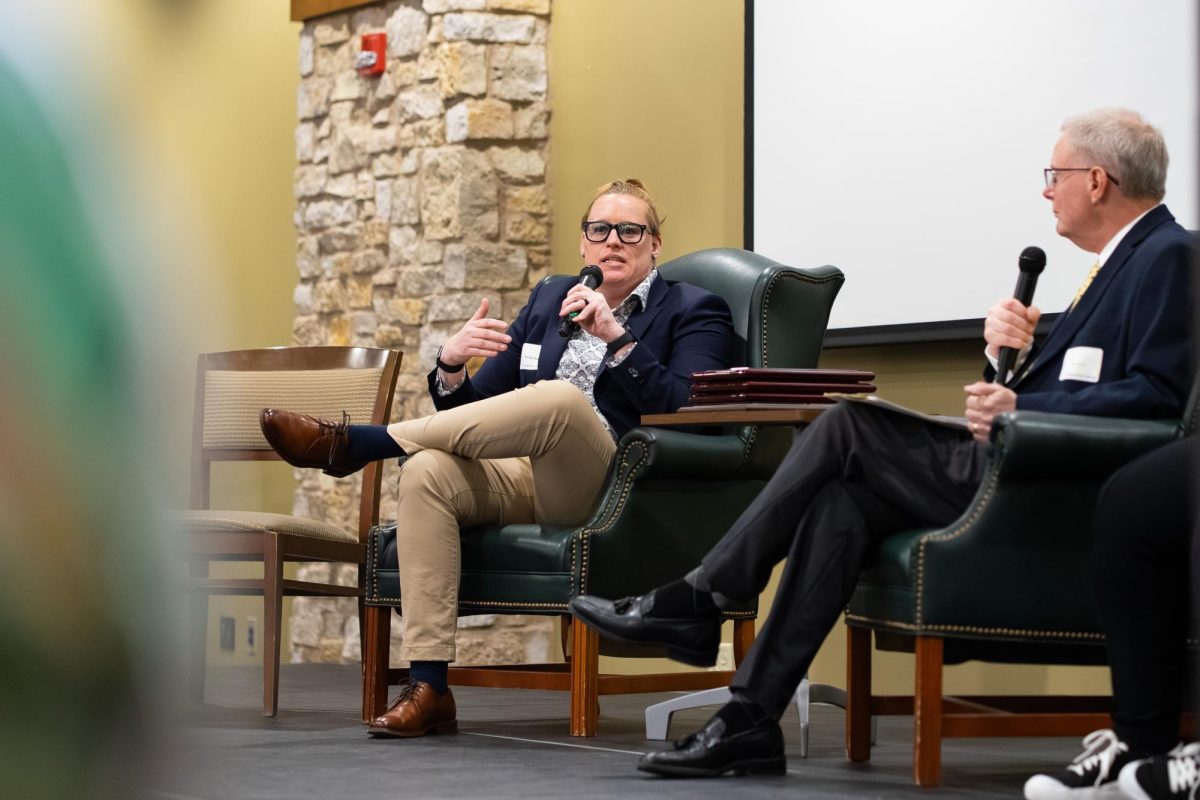


















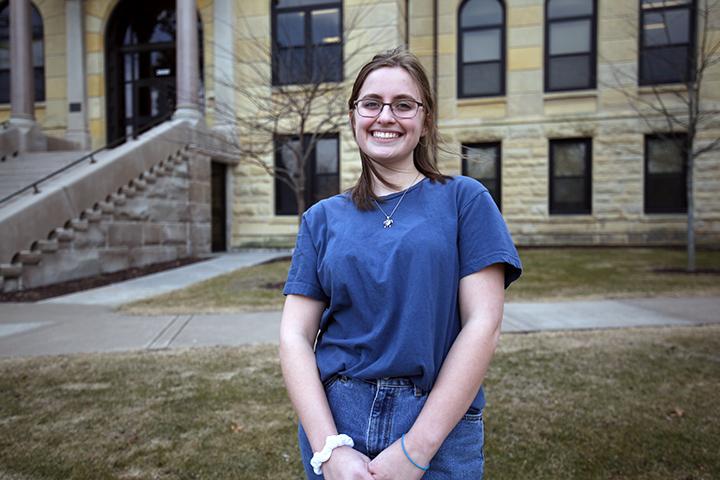





Augustana College commemorated Dr. Jennifer Burnham ‘97 as the new Edward Hamming Chair in Geography on March 4. Attendees listened to a discussion of Burnham’s 2019 research in Northern Greenland and how this research venture tested her balance between being a researcher and a mother.
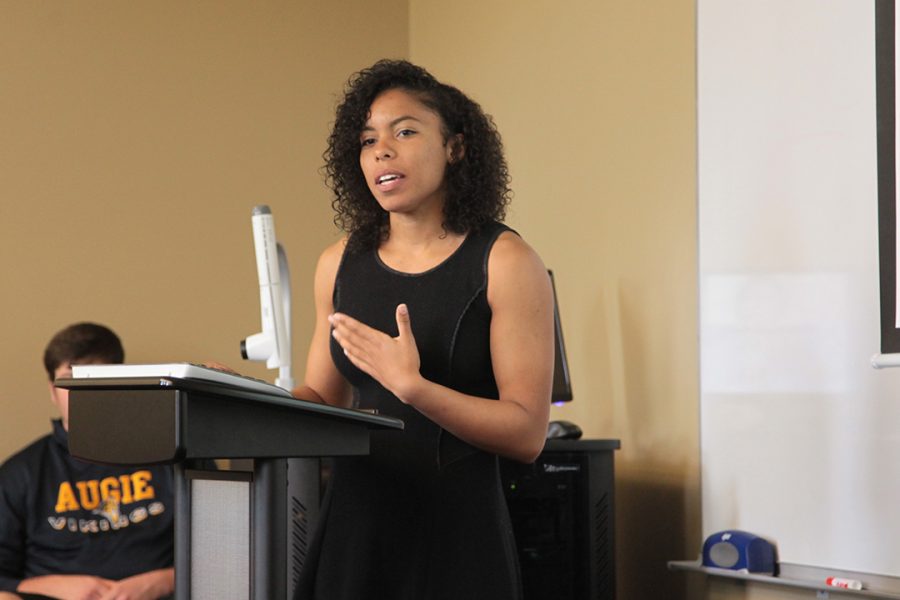
An Augie grad herself, Burnham has been a professor of geography since 2006 and is also the director of the Augustana Center for Polar Studies. To celebrate the appointment, Burnham delivered a public lecture in the Wilson Center entitled “From Augie to the Arctic: Tales from a Scientist Mother” to answer one of the principal questions of geography: Why am I here, and where should I be?
Dr. Dianna Shandy, provost and vice president of Academic Affairs, opened the lecture. She spoke about the origins of the endowed chair, which was established in 1997 by the family and friends of Augustana’s first Geography professor, Edward Hamming.
“The Edward Hamming Chair in Geography memorializes a founder, a teacher, and a builder of institutions,” Shandy said. “The chair recognizes faculty whose work reflects excellence and that characterize Dr. Hamming’s legacy.”
After her introduction, Shandy gave Burnham a medal to signify the award.
Burnham has represented excellence in the geography field since graduating from Augustana, earning her Ph.D. in Earth and Space Sciences at the University of Washington soon after. She has researched geomorphology, soil organic carbon cycling, and avian ecology in the Arctic. Her talk presented original research on Atlantic puffin migration.
“The Arctic is the most rapidly changing region on the planet in terms of climate, warming about 3-4 times faster than the rest of the planet,” Burnham said. “[The puffins] are facing dramatic changes in short periods of time.”
By conducting labor-intensive research and using geolocator technology to track puffins over tens of thousands of miles, Burnham was able to answer long-standing questions about how climate change affects migration patterns.
According to her article published in the peer-reviewed journal Public Library of Science (PLOS) One, Burnham was “the first to present data on the migratory movements of the “large-billed” subspecies.”
And yet, according to Burnham, one of the most pivotal moments of her career came in 2019, when she brought her two children to the field for the first time. Speaking to a crowd that included her husband (also an Arctic researcher) and two children, Burnham said she wanted her personal and professional lives to overlap in an intentional way.
“I was confronted with uncertainty about the collision of motherhood and being a researcher,” Burnham said. “I was forced to ask, can I be a mom and researcher at the same time?….This choice involved a high risk – taking our children to the dangerous and remote regions of the Arctic.”
With two children in tow on a small boat in the Atlantic Ocean, Burnham and her husband completed research in the summer of 2019 under a twenty-four hour sun. She discovered that her two boys, just 8 and 10 at the time, were capable of being researchers along with their parents.
As a professor and mother, Burnham has introduced many new researchers to the Arctic. One of the most important aspects of Burnham’s work is bringing students into the field and allowing them to do their own research. Most recently, in the summer of 2025, she led a two-week study abroad course entitled “Geography of the Arctic” that allowed fourteen students to experience the region firsthand.
Placing a large Augustana medal around Burnham’s neck, Shandy said Burnham exemplified dedication to Augustana, its students and the broader geographic community.
“She has quite literally carried [Augustana] from the bluffs of the Mississippi to the ice of the high Arctic.”