

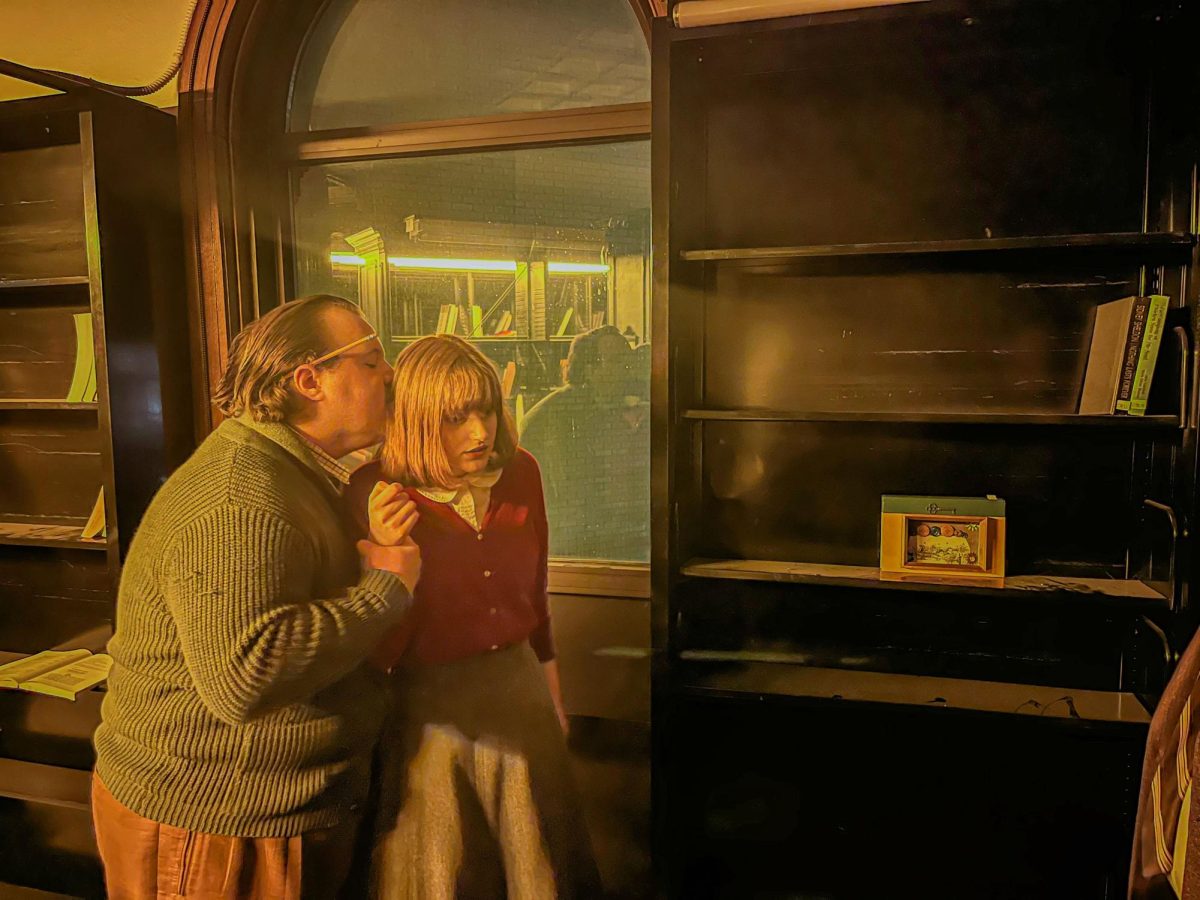












































































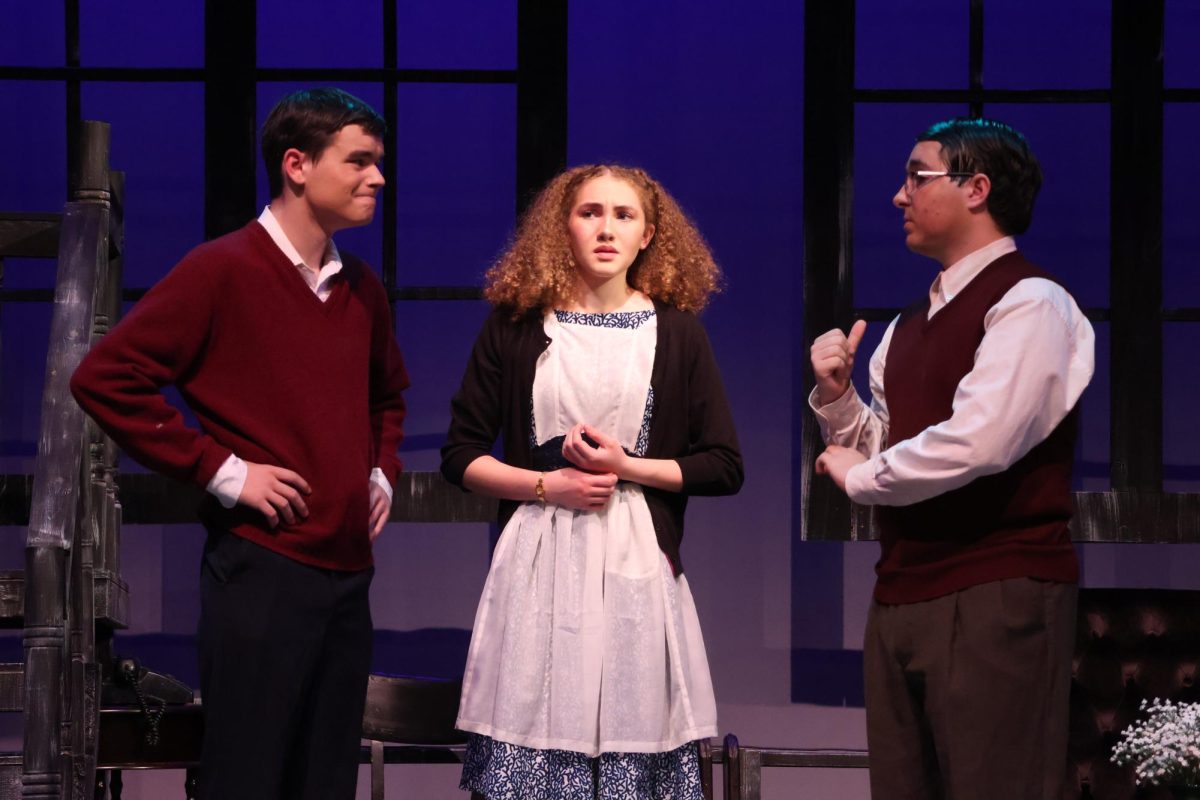
Augustana’s take on the longest-running play in theater history, Agatha Christie’s “The Mousetrap,” opened on Thursday, Nov. 13, in the Brunner Theatre Center. Professor Jennifer Popple, co-chair of the Theatre department, directed the production, bringing an explicitly queer reading to the text.
“The Mousetrap” is an iconic murder-mystery play set in a newly opened guesthouse, Monkswell Manor, where a group of strangers become snowed in during a brutal winter storm. When news breaks that a murderer is on the loose, and one of the guests is then found dead, it becomes clear that the killer is trapped inside with them.
Popple said that what initially drew her to direct a production was the queer undertones she read in the material, especially through the character of Miss Casewell, a British traveler staying at the inn described in the script as “a manly type”.
“I read that it had two possibly queer characters. Now, in the text it doesn’t go into that, but there are certainly stereotypical things in the script that let us know that they are probably queer,” Popple said.
When discussing the character of Miss Casewell, played by junior Lydia Benesh, Popple touched on the script, calling her “mannish” and exploring the balance between staying true to the text and appealing to modern audiences while presenting this story. Benesh said that she needed a lot of preparation to portray Miss Casewell.
“I actually watched videos of British women in World War II … and I used that to model my body language, how I should sit and act,” Benesh said.
Benesh’s performance in the show as Casewell was compelling and textured as she played into stereotypically mannish features, while other characters more covertly portrayed their broad archetypal roles, such as Mr. Giles Ralston.
Ralston, portrayed by junior Jack Pawlak, is the co-owner of the newly opened Monkswell Manor. In one moment, Ralston homophobically proclaims he has no patience for that “type” of person, when referring to the flamboyant Christopher Wren and his need for a picturesque room.
Popple highlighted this moment as a key point in her queer reading of this piece for modern audiences.
“The audience at that time probably would have laughed, saying, we know that type of person he’s talking about, but when we’re looking at it now, we think, Giles is flat out homophobic … the way we think about queerness and masculinity is so different,” Popple said.
The queer translation of the text was noticeable throughout the performance through the subtle in-between moments and character interactions. Popple successfully and impressively imbued the production with her thesis around a queer interpretation without meaningfully transforming the text.
Popple and the Augustana Theater Department’s rendition of “The Mousetrap” is a worthy offering to the ongoing artistic dialogue that is the evolution of the world’s longest-running play, due in part to its striking minimalist set, highly dynamic ensemble and especially its novel yet textured queer reading of its characters.