
















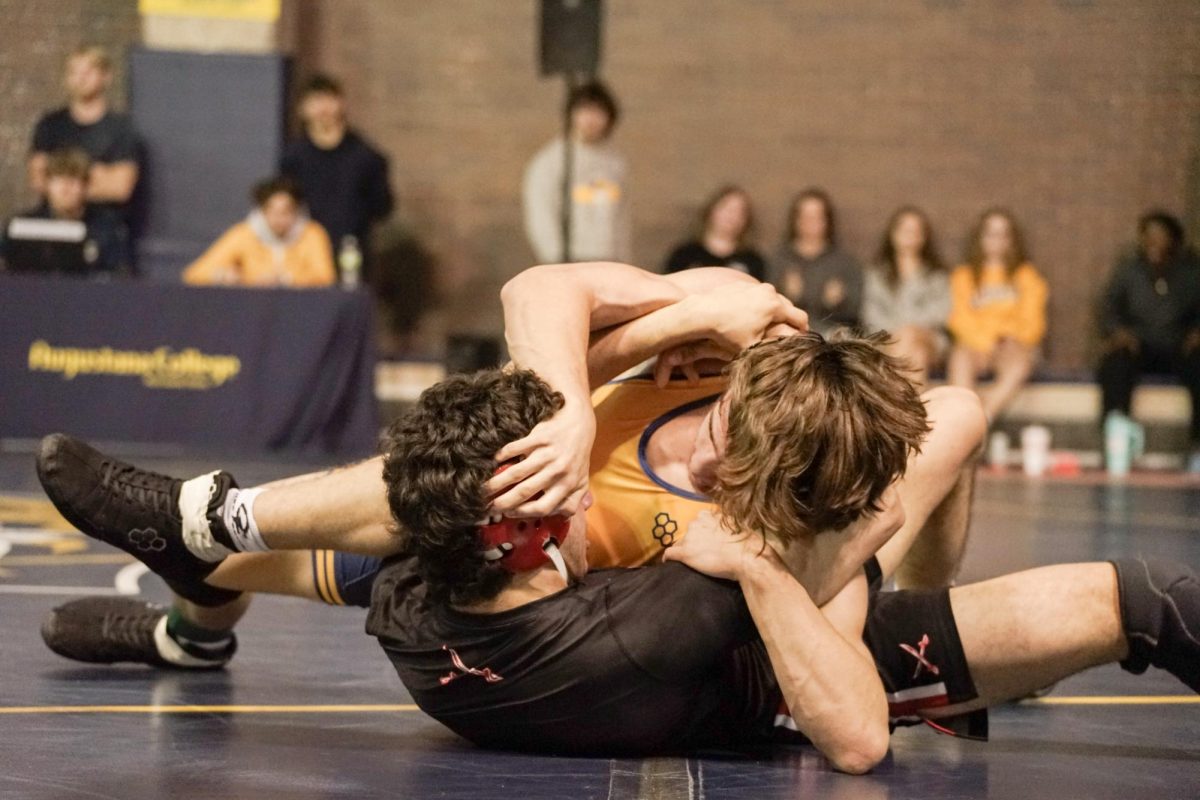
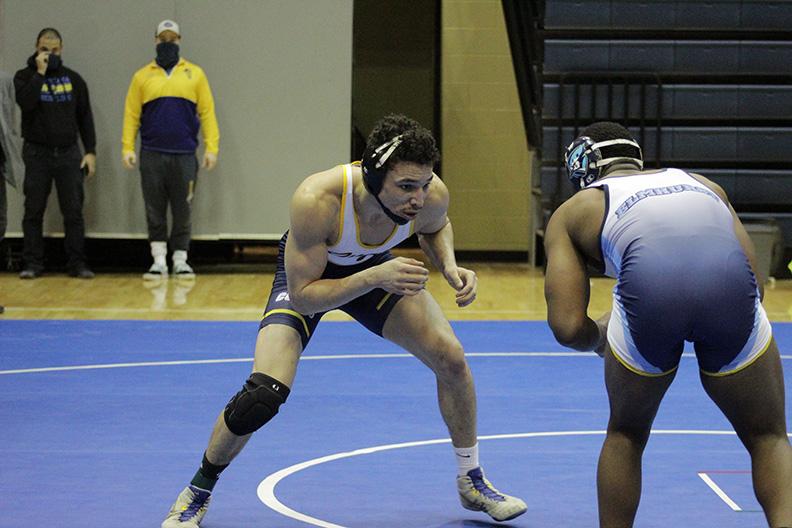

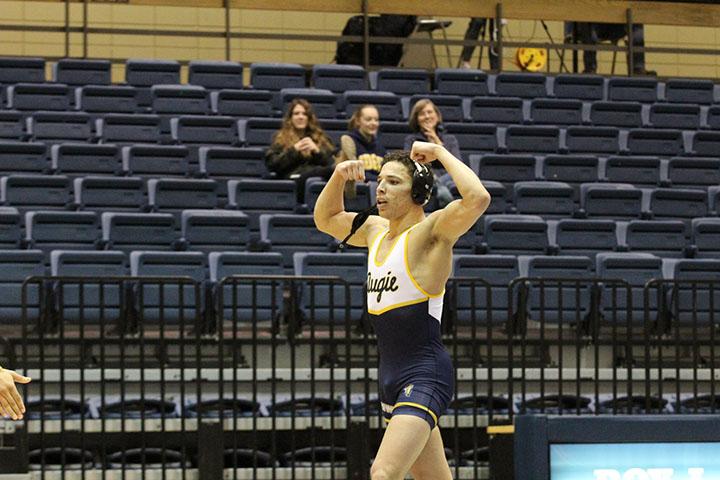





After beginning their season at the Pointer Open on Nov. 1 and craddling straight into a demanding two-week stretch of competition, Augustana’s wrestling teams said the early slate revealed exactly where they stand and what they must improve as the year progresses.
On the women’s team, senior Aine Moffit earned second in the 145 division after receiving an opening-round bye. For the men, junior Jack Miller opened the day with an 11-6 decision over Coe College at 174.
With three matches packed into a single week and four meets across just 11 days, the Vikings were thrust into midseason-level intensity almost immediately. The rapid sequence of competitions left little time for adjustments, but gave both teams a clearer sense of how their preseason preparation compared to real match environments.
For many athletes, the Pointer Open was the first chance to get a feel for the season’s pace, test new techniques and shake off early nerves. The opener also provided an opportunity to evaluate how the team’s mix of returners and newcomers would blend in live competition. With roster changes on both squads, athletes said the Pointer Open helped reveal early strengths and showed who was settling in quickly.
“We got a lot of seniors that left [and more] freshmen coming in, so you can’t really tell practice from how people are going to be creating competition,” junior Braiden Young said. “We had people that definitely exceeded expectations.”
The Vikings emphasized that improvement from last season isn’t centered on one single area, but rather on combining sharper technique, better match pacing and faster adaptation during bouts. The early practices laid the foundation, and the back-to-back competitions showed where the team could grow.
These first meets often serve as an important benchmark for refining strategies and addressing small details before conference competition intensifies.
For the women’s team, that includes adjusting technique when competing against athletes with different styles and flexibility levels. Moffit, one of the program’s most experienced returning wrestlers, said those matchups often require a more strategic mindset.
“Women are very flexible … very bendable,” Moffit said. “So you almost have to play like a chess match with your next move.”
As the Vikings moved from the Pointer Open into multiple duals and then the Luther Open shortly after, the focus shifted toward handling the volume of matches without sacrificing performance. Managing weight, preserving energy and maintaining technical focus became immediate priorities.
For veteran athletes, experience provided help in navigating the early grind, but younger wrestlers were also learning the importance of balancing preparation and recovery.
“It’s a balance of keeping your weight in check as well as realizing that your body needs rest,” Moffit said. “After an open, I’m probably going to take Sunday off.”
With a busy schedule on the horizon, both teams are bracing for the grind of multiple back-to-back matches, knowing that maintaining focus and energy will be crucial to their performance.
Each athlete has their own strategy for handling the demanding pace. Some rely on strict routines to keep their bodies and minds in peak condition, while others prioritize rest and recovery whenever possible. Nutrition, mental preparation and team support also play key roles in helping players cope with the intensity.
Despite the challenges, the shared commitment to the game and mutual encouragement within the teams help them push through fatigue and stay competitive throughout the stretch.
“It’s different for everyone,” senior Colin Roque said. “We stretch after practice and try to be aware of what we put in our bodies.”
Beyond the physical toll, athletes said the mental side of the sport becomes even more important as matches stack up. One wrestler explained that staying grounded helps keep the season enjoyable, even during its most demanding weeks.
“You’ve got to remind yourself a lot that this is for fun,” Young said. “That is a sport, and ultimately, they don’t have to do this.”
Even though the constant turnaround between matches left little time for reflection, the Vikings said the experience helped accelerate their growth. The team now has a clearer sense of its identity as they compete under pressure, how it responds to fatigue and what adjustments will carry them forward.
