

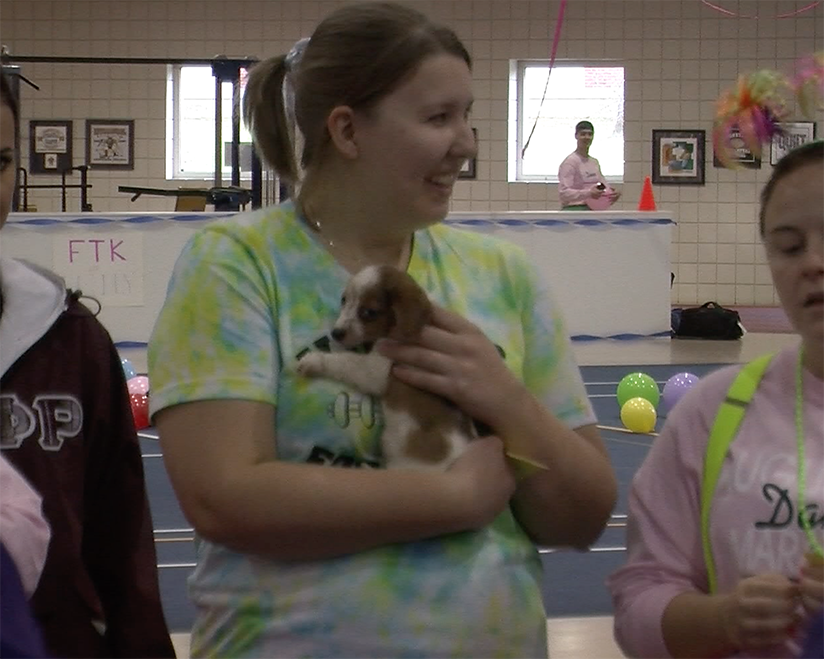















Every other Sunday, the familiar sound of paws padding across the third floor of Hanson signals the start of another Viking Pups training session. Those paws are the efforts of Augustana students and FurReal Heroes fostering, training and handling the dogs to help prepare the next generation of assistance dogs.
Alumni Sarah Rushing and Nicole Adams, who graduated in 2021, founded FurReal Heroes in Nov. 2019 after participating in Viking Pups as students on campus. Their goal was to preserve the club’s mission by providing a sustainable partnership that allows students to train service and facility dogs while promoting education and advocacy for people with disabilities.
The collaboration between Viking Pups and FurReal Heroes is built on professionalism and structure. Students follow detailed protocols while learning the responsibility of preparing a dog for their work, as junior Melissa Cook said.
Although a variety of students with different majors have joined the club, many are on the pre-vet track, such as Cook. Cook serves on Viking Pup’s executive board as the volunteer coordinator and also fosters a puppy.
“[Rushing and Adams] wanted a better service dog training organization. We do nothing without [FurReal Heroes] permission; it’s all professional,” Cook said. “They have a protocol, and there’s something for you to follow.”
Despite the busyness of campus life, if students want to work their way up to handler positions, or people who train and care for the dogs while teaching them specific skills or behaviors, they must attend the training sessions. These positions are earned through consistency, professionalism and understanding of crucial and high standards, Cook said.
Members of the Viking Pups follow strict guidelines to ensure reliability in each dog’s progress. The program requires responsibility and understanding the long-term impact of proper training. Since the dogs will go to someone one day, it isn’t just hanging out around the pups.
“It’s a lot of anxiety [because the dog that I’m fostering] is my life,” Cook said. “How I train them and how I go about this will fully affect someone else. It’s tiring, but rewarding.”
The organization’s philosophy, however, isn’t all strict. They recognize that, while service and facility dogs must perform specific tasks, they also need opportunities for recreation and socialization that allows them to be themselves.
Training sessions balance discipline with playtime, supporting the dogs’ emotional and behavioral development.
Despite training sessions being a crucial aspect of the club, what also makes it important is its advocacy for awareness and disability rights on and off campus.
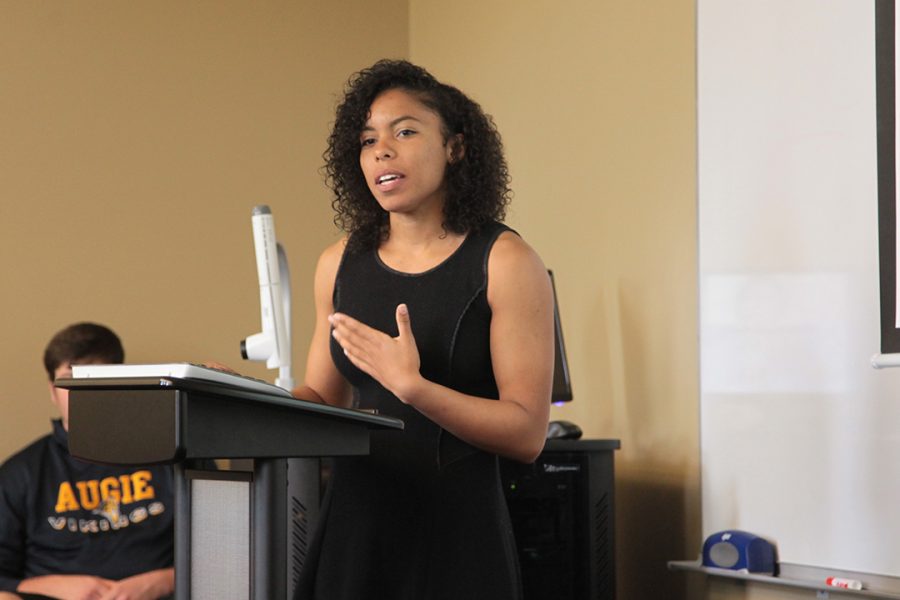
“We give awareness for service dogs and disabilities. There is no registry, no required paperwork for a dog. If you look it up in the ADA, it states there is no required paperwork for a dog,” Brianna Phroasvong, vice president of Viking Pups and foster student, said.
Phroasvong said her high school teachers were the ones who sparked her interest in becoming a vet through the vet science program offered at her high school. Since joining Viking Pups, she has taken the initiative to give a presentation about the club to raise awareness and advocate for people with service dogs and disabilities.
Spreading awareness, however, goes beyond high school and college classrooms; it’s also out in public where many don’t understand the rights that service and facility dogs have, even within store and restaurant settings. Doing so, gives the voice to the voiceless –the dogs and the people.
“A lot of people try to test their limits in restaurants and stores… we have the White Cane Law which protects us… it’s important because a lot of people with service dogs don’t really have the confidence to stand up for themselves… so it’s nice that there’s more people out in public that can do that for them.,” Phroasvong said.
Junior Maggie Stanley, handler in training and on the pre-vet track, has seen subtle differences between being a handler in Viking Pups and the vet world.
“There’s a reciprocal relationship that people have with their animals. At the animal hospital, I see more how humans are caring for their pets, but I think on the service dog side of it, you’re seeing more how the dog reciprocates that and how it’s helping people, too,” she said.
Beyond what she is learning in class, Viking Pups has strengthened Stanley’s understanding of animal care and service work.
Despite not seeing the impact that training service dogs wil have on the person they are paired with, they are essential to help take care of people’s mental and physical health, Stanley said.
Not only is the impact upon the human the dogs are paired with crucial, but it isn’t just whomever is available. Throughout the training sessions, what skills the dogs are good at and love won’t go unnoticed. Otherwise, that can lead to boredom in what they do, which isn’t good for high-risk situations.
No client is paired with just “any dog.” Instead, the dog is matched to the client, so that they’re doing what they are good at and love, alongside the person they are paired with, Cook said.
Biology professor and Viking Pups advisor, Dr. Tim Muir, said that the training process itself reflects key biological and behavioral patterns.
Living beings and how they function are the product of their genetics and environment, he said.
Often the more humans repeat a task, the likelihood of them getting better at it will increase or become like second nature. Similarly, consistency within training dogs will go a long way.
“Through the training, that’s going to affect the dog’s behaviors. Behaviors are manifestations of physiology, no matter how complex they are, even in us, whatever we decide to do is a manifestation of the chemistry of our body. And so as the dogs are being trained, their phenotype is being changed.”
Dogs are social beings. They are some of the few animals that can read facial expressions and people’s emotions. Through this, there is a unique sense of communication between humans and dogs.
The training process isn’t always easy, but having that connection with the dog can make it a bit smoother.
“It’s pretty incredible we can do this cross-species communication. They can understand, and we can understand, to a lesser extent, their needs,” Muir said.
As with training any dog, the collaboration between humans and dogs requires patience and consistency, especially when it comes to training service and facility dogs, which go to people who truly need them in crucial or dangerous situations.
“Repetition is everything with puppies. We just keep walking through until they understand they’re supposed to be paying attention,” Cook said.
For students, each session can go beyond obedience training. Students receive an opportunity to gain hands-on experience that connects academic learning with empathy and service.
“It’s giving me a different type of experience than I was able to get before with working with animals, but in terms of helping me learn and further my career,” Stanley said. “I’m learning stuff in my biology class and my chemistry classes about how [scientific concepts and processes] affects people [and] how it affects animals … and it’s kind of cool because it’s like not only am I working with these dogs… but I’m also learning about how these dogs are helping with those things.”
Despite the challenges and anxiety that come with training the next generation of service dogs, the end result will be meaningful for their owners, with whom they will also build a connection and bond.
Through professionalism, consistency and advocacy, Viking Pups and FurReal Heroes provide students with more than just a volunteer experience. They offer something that will have a strong impact in the end, one paw at a time.
Training sessions meet every other Sunday at 5 p.m. in Hanson 337
Meetings are held on Mondays at 5 p.m. in Hanson 102