












































One of the many fall 2025 Symposium Day events held on Wednesday, Oct. 8 was the opening of the HEXAD art exhibition in Centennial Hall. Paintings, sculptures and wood lettering were among the many art forms lining the entrance. Created by the Augustana Art Department, the professors and ART 241 sculpture class from last spring came together to display their varying talents.
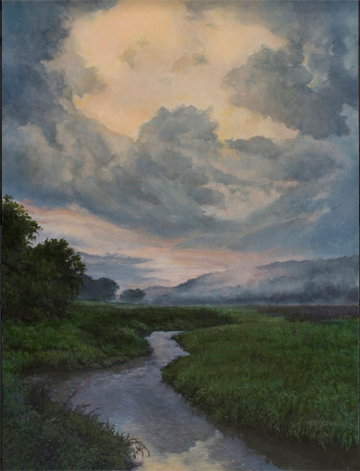
When entering, to the left, the first piece that meets your eye is a collection of three paintings by Professor of Art Peter Xiao. While two of the pieces illustrate a straightforward perspective of an image, “Panorama (Whirligig)”, the largest of the three does not. It is a wheel made up of four painted panels that, altogether, create a full 360-degree view of Xiao’s studio, the only place he works.
“The reason I do that panorama view results from puzzling about what happened with art…I think that results from not [being] content [with] duplicat[ing] what a camera captures, which is the distance, but rather deal[ing] with [that distance],” Xiao said.
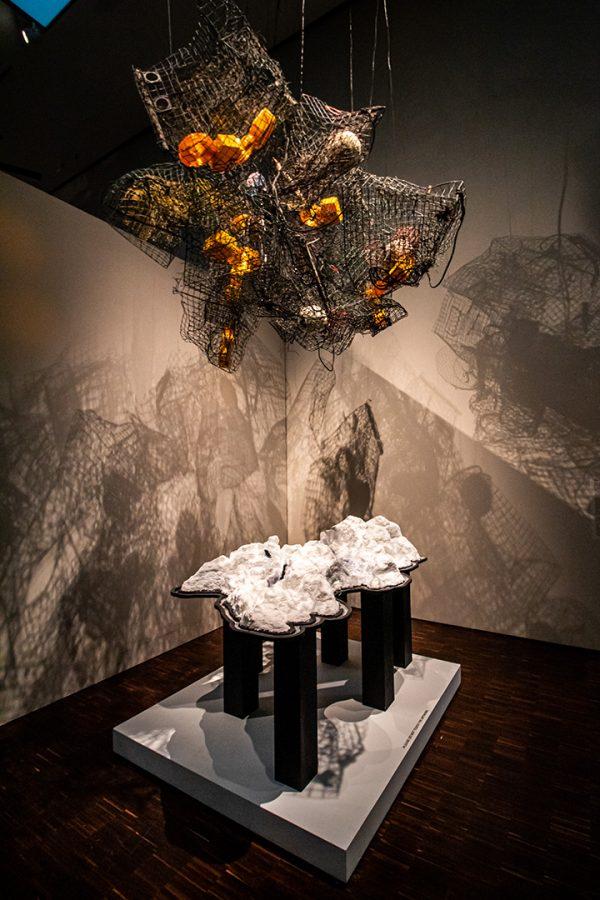
Tucked into each corner of the Hall is the only representation of student work in the exhibit. In groups, the ART 241-01 sculpture class of spring 2025 worked together to create four sculptures surrounding pollution. Guided by professor Anne Heide, they learned about water pollution from the Upper Mississippi Center and used their research to inspire the art located in each of the four corners of the gallery.
Another faculty artist featured at the show is professor Vincent Frimpong. His display contained three sculptures, each made from clay and metal that are arranged with two smaller pieces on either side of a larger piece in the middle.
“Dreamer”, on the left, is a metal machine covered in gears. On the right stands “Life Sweeties”, a rounded brick-styled cone. The largest piece, “Codex”, is a large vase topped and surrounded by gears.
Frimpong’s inspiration for this series was his dad in Ghana and how he feels about the absence of his presence at important events.
“So in a way, I am using clay, found objects [and] metal to channel the emotional weight into the sculpture,” Frimpong said.
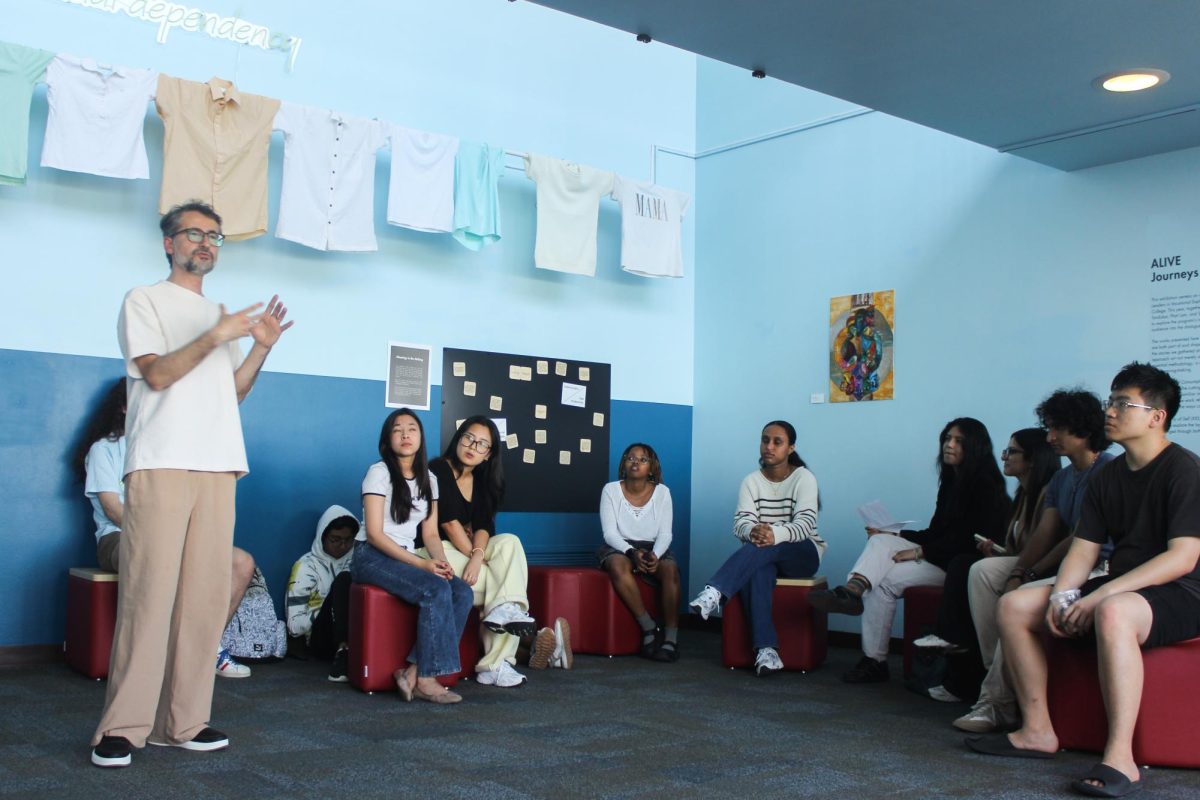
To the right of his display is professor Larissa Frimpong’s, who created several small pieces in different mediums. The project “footnotes: a love practice” connects fashion and the presence of community, in particular that of people of color. The visual display consists of T-shirts and quotes hung on the walls, as well as polaroids and copies of a small booklet covering a table.
The polaroids were taken in celebration of Frimpong’s completed master’s thesis. In many of them, people are posing for the camera, but some are candid shots of Frimpong’s loved ones celebrating her success.
In a display alcove is professor V Phipps’s installation of prints and lettering inspired by the work of Monique Wittig, a French author and feminist theorist. Quotes and symbols from Wittig’s book “The Straight Mind and Other Essays” were used to portray some Wittigian ideas that stand alone outside the context of the essay.
“It’s really about the fact that we all coexist together, and if we can’t see each other, then it’s hard for a person to exist [because] we put them in little boxes,” Phipps said.
The HEXAD exhibit will remain in Centennial Hall until Dec. 8.